If I could re-title any of the papers I’ve written so far, “To breed or not to breed? Maintaining genetic diversity in white sturgeon supplementation programs” would be the one. But it’s nevertheless a good paper, and has had a decent impact since publication. Unfortunately, the Shakespeare reference is clearly not an original thought.
It covers an important topic: when we have to supplement wild populations, how do we maximize genetic variation? The world is undergoing a sixth mass extinction, largely thanks to humans. It’s practical to directly help many species that need conservation attention, such as by taking them in to captivity to grow to a larger size or to breed, where their young can be released and survive in hopefully greater numbers than they would in the wild. That’s the supplementation bit- we sometimes supplement wild populations by nudging individuals along. Related practices are reintroduction programs, where species are put back into places where they used to live.
White sturgeon
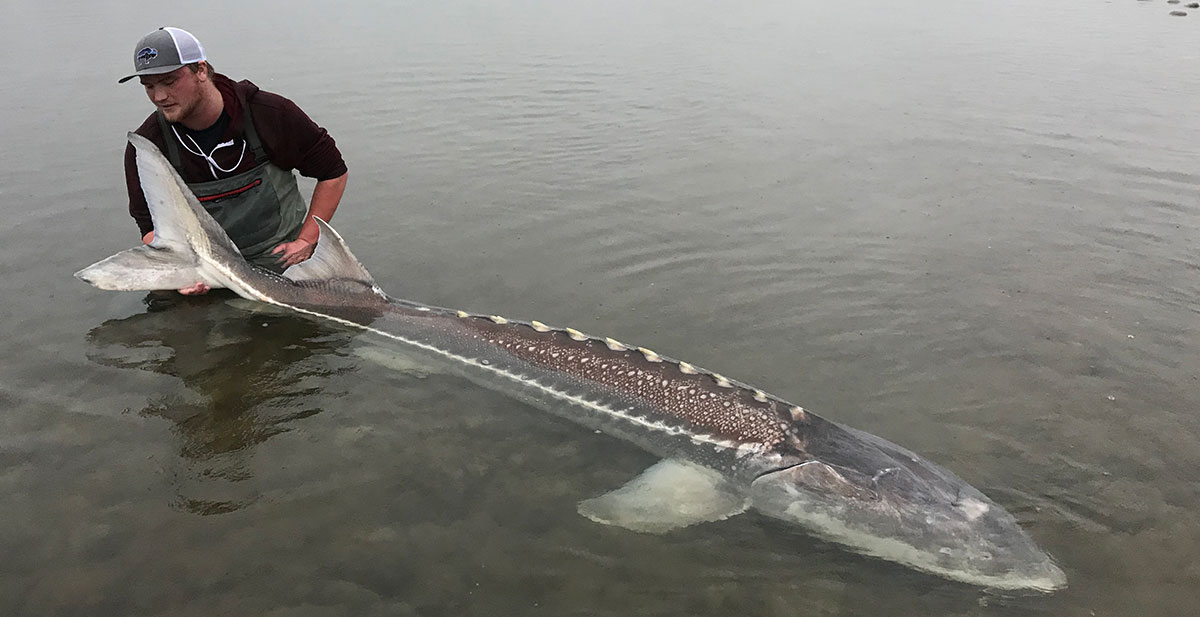
White sturgeon certainly need the help. They’re remarkable fish, with Jurassic-looking scutes on their sides and they grow to enormous size. Scientists call sturgeons ‘living fossils’, partly because of how they look, and partly because they literally resemble their fossils from tens of millions of years ago. However, white sturgeon are listed as endangered under both Canada’s Species at Risk Act and the United States’ Endangered Species Act.
The Idaho Power Company is one of several groups that does conservation supplementation with the white sturgeon, and they funded this study. What they and other groups normally do is catch adult male and female white sturgeon before spawning season in the Spring, cross their eggs and milt, then release adults. The young are raised up, then released after some time. That’s a normal supplementation program. The Idaho Power Company’s program is in the Snake River of Idaho, which has some awesome waterfalls.
Our study
What we all wondered was: what’s going on with genetic variation when someone catches a few adults for supplementation? Again, white sturgeon are huge, so no one could keep too many for spawning. And if someone knew where they spawned naturally, could the eggs get sampled after they get spawned naturally and raised up? That way, the dangerous first year of life could be avoided by staying safe in a hatchery, while maybe more genetic variation would be maintained by having the offspring of more parents raised up. For brevity, we called this second way of doing things ‘repatriation’, since young are taken out of a river, raised up, and repatriated back into it. Our study compared those two methods: broodstock and repatriation versions of a supplementation program.
The folks at Idaho Power got us nice eggs or tail clips on which to do genetics, but sturgeon make things tricky for genetics in an unusual way: they are polyploid. That is, they have many (poly) copies of each chromosome (ploid). We humans have two each so we’re diploid, but white sturgeon are octoploid, with 8 copies of each. Ridiculously, they can sometimes get 12(!) copies of each chromosome which makes some of them dodecaploid, but we did not need to deal with the 12 copy thing here. Relevant for us doing genetics on these animals, we have to address how to measure genetic variation and other stuff with such weird ploidy issues.

Most population genetic tests such as FST, or approaches for delineating groups such as STRUCTURE assume diploid data, since a huge number of the organisms scientists are interested in are diploid. Humans, fruit flies, and so on. Andrea Schreier, my supervisor at the time of doing this paper, spends a lot of time thinking about how to deal with these higher ploidy issues and genomics. One approach she uses, and that we used for this project, was to code each allele as a genetic marker. Normally, for diploids a genetic marker has some values to show different alleles in it- 0, 1, and 2 for homozygote reference allele, heterozygote, and homozygote alternate allele is one common format. Another common format is 11, 12, and 22, where the 1’s and 2’s literally refer to alleles (the 12 being a heterozygous genotype at a marker). Another is 0/0, 0/1, and 1/1, which is where the 0’s and 1’s instead refer to alleles. But with polyploids, the data can become a table of 0’s and 1’s, where a 0 means the allele is missing from an individual, and 1 means it’s there. Unfortunately, if an allele is present, we do not know how many copies of it is there- it could be anywhere from 1 to 8 copies with octoploid white sturgeon. In any case, the data format works, and are called ‘pseudodiploid-dominant genotypes’ when they’re in the format.
One place the data format is particularly suited is in pedigree reconstruction. That is, estimating the family relationships in a set of samples. For our purposes, this boils down to defining full siblings (brothers and sisters), half-siblings, or non-siblings since the samples we had were from particular years. This sibling information is useful for defining the number of parents represented in a group. One thing we want for the white sturgeon is to maximize the genetic variation we’re putting back in the river with these conservation programs. And one way to maximize genetic variation is to maximize the number of parents represented by a group of fish that we release. That idea is the core of the paper. Which method, broodstock or repatriation, helps us represent the greater number of parents for fish we raise up and release into the wild?
Repatriation. By far. No cliffhanger or plot twist here. In this case, it was by much better than catching adults to breed in a hatchery (broodstock sampling). Using the program COLONY with the special data format for polyploids, it identified the number of ‘spawners’ or parents present in each of several years of data for when the Idaho Power Company was trying repatriation. And the number of spawners present for the years they tried the broodstock sampling required no statistics or genetics or anything fancy at all; they just needed to count the number of adults used in each year, which was 3 males and 3 females. By contrast, the repatriation approach gave us a minimum of 24 spawners represented in each year, and up to 166 in one year (Table 2 in the paper).
Genetic variation was much higher for the repatriation groups, as well. We could not use more typical measures such as heterozygosity because of white sturgeon’s polyploidy (but it might be possible now?). However, we could use something analogous to allelic richness– the number of alleles, or literally counting up how many alleles were present among different groups. Here again, repatriation beats out broodstock sampling for maintaining genetic diversity in white sturgeon. The number of alleles captured in offspring with broodstock sampling was 77 and 82 in two years of sampling, while the three years of repatriation sampling we tested gave us 101, 105, and 107 alleles in each. That’s around a 31% increase in genetic variation represented in offspring for supplementation, using back-of-the-napkin math.

Another paper did criticize the way I calculated the intervals for estimates of the number of spawners using Colony because the program uses a maximum likelihood approach to give its point estimates of sibling relationships. Fair enough, I’ve learned more about statistics since working on this project. The biological point, however, is just as strong as before: repatriation is better than broodstock sampling for white sturgeon supplementation. Heck, the biological conclusion might actually be stronger if we took Colony’s point estimates for the number of spawners in a dataset, because a human tendency is to look at the lower bound of an interval as a minimum value, but the point estimates from Colony will naturally be higher than the lower bounds I identified.
Who cares?
The Idaho Power Company cared, for one. In the 2022 meeting of the North American Sturgeon and Paddlefish Society, I got to see a talk about what they’d gotten up to since I worked on white sturgeon genetics. They have built new facilities and come up with whole new ways of raising up sturgeon eggs based on this idea that repatriation is better for conservation than broodstock sampling. It’s hard, tricky work because eggs they get from the wild are covered in all sorts of gunk from the river, which messes with high waterflow systems that they need to keep the eggs alive. But they’re doing it.
Anyone who is thinking about running a supplementation program might care about this idea of repatriation, as well. Genetic variation matters for conservation, and an approach that increases the genetic variation being released into the wild from a supplementation program is worth considering. We wrote about caveats though, such as the fact that spawning/nesting/breeding sites need to be known about to capture young individuals for raising up. That’s not possible sometimes, and white sturgeon work for that criterion because a population will come back to similar areas to spawn each year. It’s probably most effective in species that have lots of offspring as well, since it might be impractical to raise the offspring of a less fecund species. Could you imagine capturing a baby elephant to raise up and release? Also, parental care. Since repatriation as we describe it involves capturing offspring to raise them up for release, then it wouldn’t work for any species that needs parental care.
As of writing this post, the paper has 23 other papers citing it. That’s no Lowry protein assay, but it’s no slouch either. To me, the references from other scientists speak to the broad interest in sturgeon conservation worldwide and the interest in different strategies for conservation supplementation. While it’s a global tragedy that such conservation action is necessary, I’m glad there are people who are doing what they can for the natural world.
If you’d like a copy of this paper, email me! matt.thorstensen[at]gmail.com
 Dr. Matt Thorstensen

Pingback: Double Duty for RNA: Part 1 | Dr. Matt Thorstensen